Thursday, September 22, 2016

Melinda in Conversation with Francoise Giroud


When I met her, in her apartment on the Right Bank in Paris, I asked her why she had steered clear of feminist ideologies. She gave a smile that reminded me of the radiant, seductive expressions of the French anchor women. It was an expression designed for the camera; but it was also a rather vulnerable and friendly expression of someone attempting to please.

“I’m allergic to ideologies, in general. I’m interested in observing them and trying to understand why they arise, but I’m profoundly skeptical. I’m incapable of adhering to an ideology. I believe that the MLF [Women’s Liberation Movement] in France was the extreme culmination of a very powerful movement throughout the world. And it did have its roots in history. Feminism is a very ancient movement, but perhaps, for the first time, it has really achieved something. In France, in the nineteenth century there was a great deal of feminist activity, in England, they managed to gain the vote, but the movement failed in France. But actually, having the vote is really not the key. There are only two essential elements that can change women’s role in society: birth control and the women’s participation in the economy.”


For more on Francoise Giroud click here


Wednesday, September 21, 2016

New Exhibition Now Open!


http://melindacamberporter.com/gallery/series/artwork/1031/

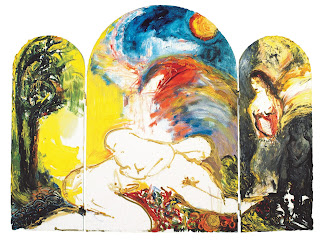
Melinda Camber Porter (1953–2008), Triptych Series No. 4: The Triumph of Nature, Part I, 2000, oil on canvas, 36 x 48 in. (overall)

University of South Dakota

Vermillion, South Dakota September 19–October 14

Though most of her life was spent in London, Oxford, Paris, and New York, the late artist-writer Melinda Camber Porter adored South Dakota, the native state of her husband and the setting of her novel Badlands. Now the University of South Dakota is presenting an exhibition that features all 90 of her Luminous Bodies watercolors and all 27 of her large triptychs painted in oils on canvas. Often inscribed with Camber Porter’s poems and musings, these works are best seen all together to underscore her objective of healing the rift between the body and the soul.

John A. Day Gallery and Exhibition Hall | 414 E. Clark Street | Vermillion, SD 57069
jjljlkj

Thursday, September 8, 2016

Melinda in conversation with Jean-Louis Barrault

[Barrault] is a friendly, and ultimately comforting person to talk to. Age has not worn out his enthusiasm, or his energy. His first concern when we met was to make sure I was at ease, so he asked me to lead him to the part of the theater where I would feel happy conducting the interview.

"I gradually realized that one eventually encounters destiny. And I believe destiny is something that is exterior to oneself."

"There is only one religion for me, and that's love of humanity. So I believe that one has to sow the seeds of a celebration, and of mutual friendship, and within that atmosphere, in the theater, one can say things to people."

"There are two kinds of works: There are plays that fall like fruit from the tree, which don't really belong to the poet. And then there are works that poets create which they never complete. And these works stay within them for the rest of their lives. The umbilical cord is never cut,"

Read the full interview from Through Parisian Eyes here.

MelindaCamberPorter.com 

Wednesday, September 7, 2016

Now Available: The Triptych Series

Melinda Camber Porter's Triptych Series is now available in a beautiful hardcover edition from Blake Press.

Preview the book here


The Triptych Series consists of a series of twenty-seven large oils on canvas exploring the triptych form as both altarpiece and sculptural shape. However, the traditional subject matter of the altarpiece is merely hinted at, with only occasional apparitions of guiding saints and visiting angels who bless the lovers’ union that is the central theme of the series.

All of Melinda's books are available at Amazon.com

MelindaCamberPorter.com

Friday, September 2, 2016

Melinda in conversation with Regis Debray


Régis Debray was sitting in his office in the Elysée looking disdainful and extremely bored. I had arranged to meet him the day before he was to leave the Elysée for another post which, as he had stated in the press, had “no political significance.” This was quite true. Debray’s career has always been a problem for his friend, President Mitterand, because of Debray’s guerilla past in Bolivia and his continuing outspoken resentment of anything American. But the French have the capacity to honor their rebels and eccentrics.

Regis Debray in 1968
 “There are many fools who say that writers never have political positions, and that by definition a writer is a pariah and a marginal, passive type who lives in the catacombs of his attic. All that is pure myth.”

“The intellectuals have always had importance in France since the eighteenth century. They have a power which they have never exercised in any other country. In the States, an intellectual is considered and ‘egghead,’ which is a pejorative term. In England, too. In France, it’s completely different.”

“Only a writer can imagine himself as another, and only a writer can act of behalf of other people. Only a writer can act on behalf of humanity with a big H.”

“A lot of people fee that poetry is a short cut to philosophy, and that, I think, is a disaster. The idea that poetry must be intellectual, that poetry must be understood and not felt. All that contributes to the drying up of the literary scene in France.”